
Executive Answer
Ultra-high-net-worth individuals (UHNWIs) prioritize destinations offering absolute privacy, low guest density, and authentic environments over mainstream luxury hotspots. The most exclusive travel destinations—including Namibia, Botswana, Antarctica, Svalbard, Bhutan, Patagonia, Greenland, and the Galápagos Islands—are chosen for their untamed space, conservation focus, and experiences that are difficult to replicate. Successfully executing these journeys depends on expert journey design using frameworks like the Bliss Journey Design Method, which reduces travel friction and aligns properties (such as private villas and luxury wilderness camps) with traveller intent.
Executive Summary
- For decades, luxury travel was defined by recognizable symbols: five-star hotels, first-class flights, Michelin-starred restaurants, and destinations that appeared on every luxury magazine cover. Today, that definition has changed.
- For many HNWIs, UHNWIs, entrepreneurs, family offices, and multi-generational families, luxury is no longer about spending more. It is about experiencing more of what matters while thinking less about everything else.
- The world's most discerning travellers increasingly choose destinations that offer genuine privacy rather than popularity, extraordinary natural environments instead of crowded landmarks, and personalised journeys instead of pre-designed itineraries.
- This guide explores the characteristics that make a destination genuinely exclusive and introduces some of the world's most remarkable luxury travel experiences.
Why the World's Wealthiest Travellers Choose Different Destinations
One of the biggest misconceptions about luxury travel is that affluent travellers simply choose more expensive versions of the same holidays. In reality, the opposite is often true. As travellers gain more experience, their priorities evolve. Instead of asking "Where is the most luxurious hotel?", they begin asking much more thoughtful questions. Aligning journeys with traveller intent prevents beautiful destinations from becoming disappointing experiences.
"The wealthiest travellers rarely ask for more. They ask for better. Better conversations. Better pacing. Better access. Better memories."
Amisha Shetth, Founder of Bliss Travels
Destinations such as Botswana, Namibia, Antarctica and Bhutan have become increasingly desirable because they naturally support these priorities. Rather than overwhelming visitors with attractions, they offer extraordinary landscapes, low visitor numbers, expert local guides, and slow travel. For discerning travellers, these qualities create far more lasting memories than simply staying at another luxury hotel. The destination becomes the setting, not the objective.
What Makes a Destination Truly Exclusive?
Many destinations describe themselves as "luxury." Very few are genuinely exclusive. Price alone does not create exclusivity, nor does staying in a five-star hotel. Experienced travellers evaluate destinations using a very different set of criteria.
1. Privacy & Low Guest Density
For many experienced luxury travellers, privacy has become one of the strongest indicators of genuine luxury. While luxury was once associated with famous hotels and popular destinations, many HNWIs and UHNWIs now prioritise space, discretion, flexibility, and uninterrupted time over visibility. Quiet luxury is defined by the freedom of absolute privacy rather than public display.
Definition: Quiet Luxury — Quiet Luxury in travel prioritizes understated elegance, privacy, low guest density, and authentic cultural connection over visible extravagance. It focuses on exclusive-use properties, private villas, and highly personalized service delivered with discretion.
True privacy isn't simply staying in an expensive hotel. It usually includes exclusive-use villas, private residences, low-density safari camps, small expedition ships, private islands, and dedicated guides. These elements allow travellers to experience a destination on their own terms rather than according to someone else's timetable. As Amisha Shetth explains, true privacy creates space for genuine emotional connection.
"Privacy isn't about hiding from the world. It's about creating enough space to reconnect with the people you chose to travel with."
Amisha Shetth
2. Access That Money Alone Cannot Buy
Luxury is often confused with purchasing power. Exceptional travel is built on access. Many of the world's most memorable experiences are available not because someone paid more, but because they worked with people who knew how to make them possible.
Exceptional access often includes private conservancies with limited visitor numbers, specialist wildlife guides, helicopter journeys into remote landscapes, and conservation-led encounters. These experiences are rarely discovered through online booking platforms. Instead, they are the result of trusted relationships developed over many years with local partners, hospitality groups, conservation organisations, expedition operators, and destination specialists.
"Luxury isn't having more options. It's being shown the right ones by people who know the destination intimately."
Amisha Shetth
3. Exceptional Nature & Sense of Place
Many of the world's most exclusive destinations share one defining characteristic: they cannot be replicated. Luxury hotels contribute to the journey. Nature creates the memory. Examples include Namibia's silent desert landscapes, Botswana's Okavango Delta, Antarctica's untouched polar wilderness, Bhutan's Himalayan monasteries, Patagonia's dramatic mountain scenery, and Greenland's immense ice fjords.
"The destinations people remember for decades are rarely the busiest. They're the ones that made them feel wonderfully small."
Amisha Shetth
Many discerning travellers now consider extraordinary natural environments to be one of the greatest luxuries available. Rather than adding more activities, they create more meaningful moments. The world's most exclusive destinations are memorable because of how they make travellers feel—not simply because of where they stayed.
The World's Most Exclusive Luxury Destinations
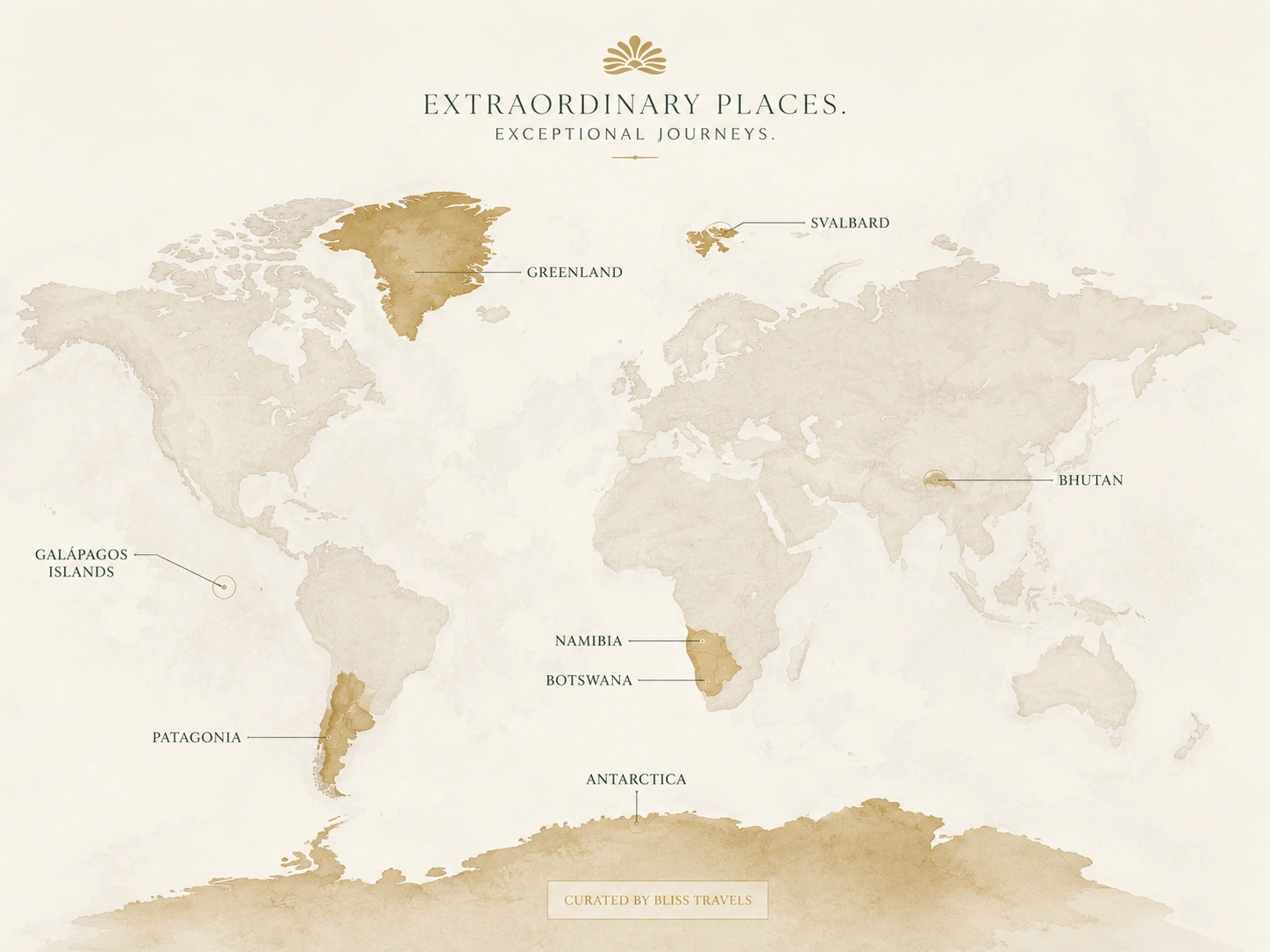
The world's most exclusive destinations offer experiences that are difficult to replicate anywhere else. Rather than focusing on luxury alone, these destinations combine privacy, exceptional natural environments, expert local guides, thoughtful pacing, and highly personalised experiences.
Namibia
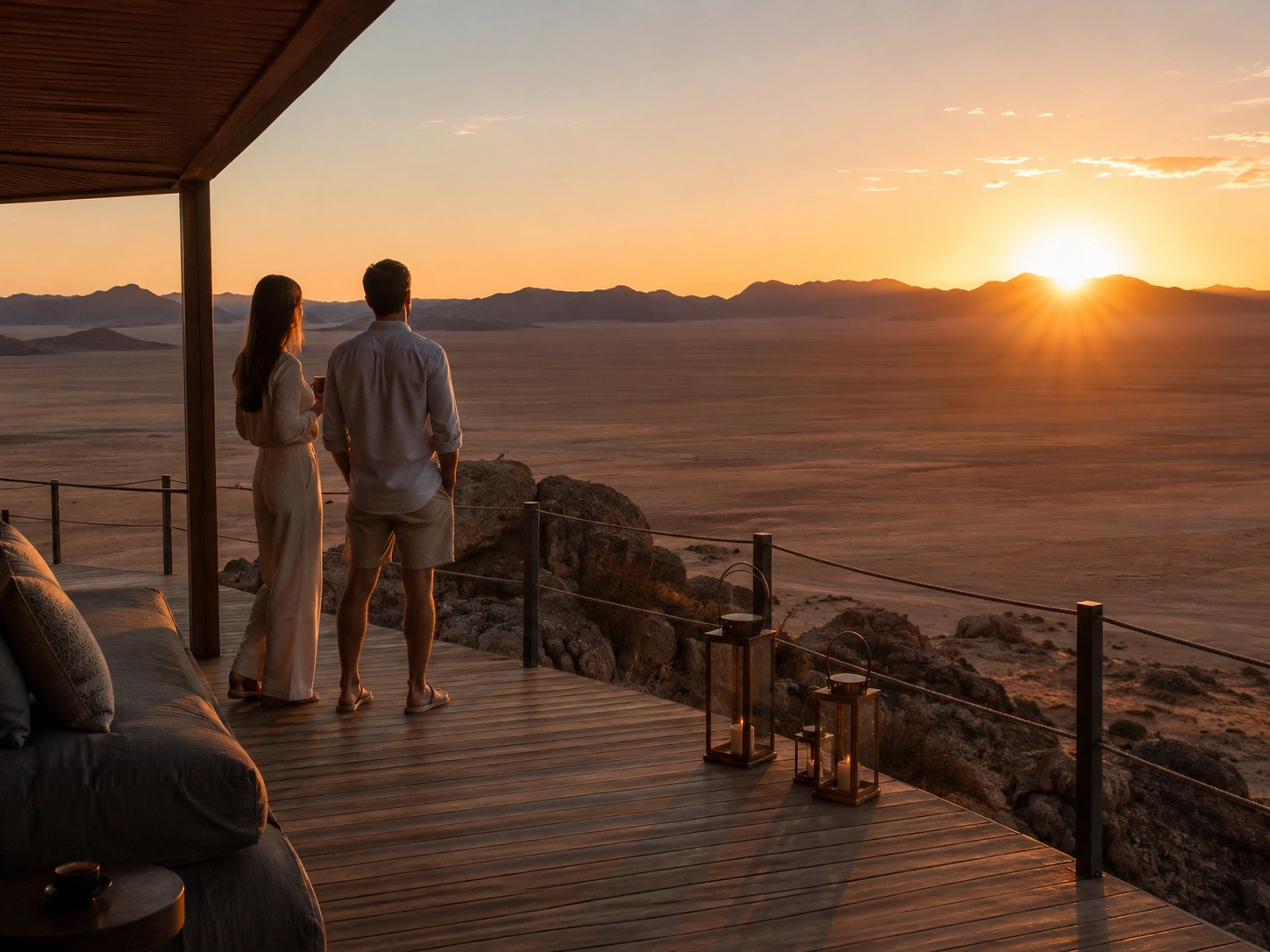
Namibia offers something increasingly rare in modern travel: space. Its vast desert landscapes, low visitor numbers, and remarkable night skies create an environment where travellers can completely disconnect from busy routines. Luxury journeys often combine private desert lodges, scenic helicopter flights, wildlife conservation experiences, stargazing with expert guides, and cultural encounters with local communities. Namibia is best for solitude, photography, desert landscapes, and slow luxury travel.
"Namibia isn't about seeing more. It's about finally having enough space to notice everything."
Amisha Shetth
Botswana
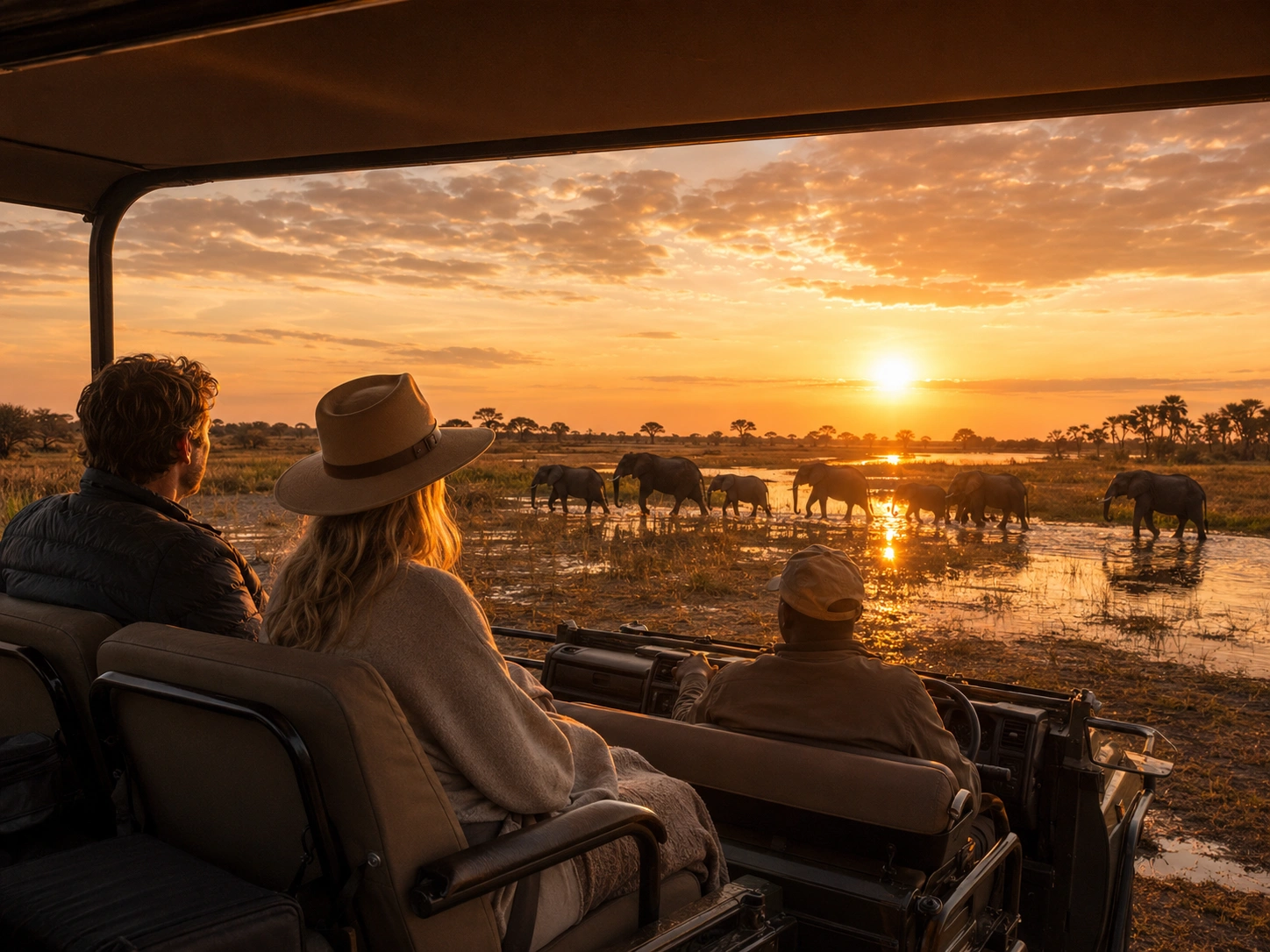
Botswana has deliberately prioritised low-volume, high-quality tourism, making it one of Africa's most exclusive safari destinations. Many luxury camps host only a small number of guests, allowing for highly personalised wildlife experiences. Highlights include Okavango Delta safaris, private game drives, mokoro canoe safaris, walking safaris with specialist guides, and luxury tented camps. For travellers seeking wildlife without crowds, Botswana remains one of the world's benchmark destinations.
Antarctica
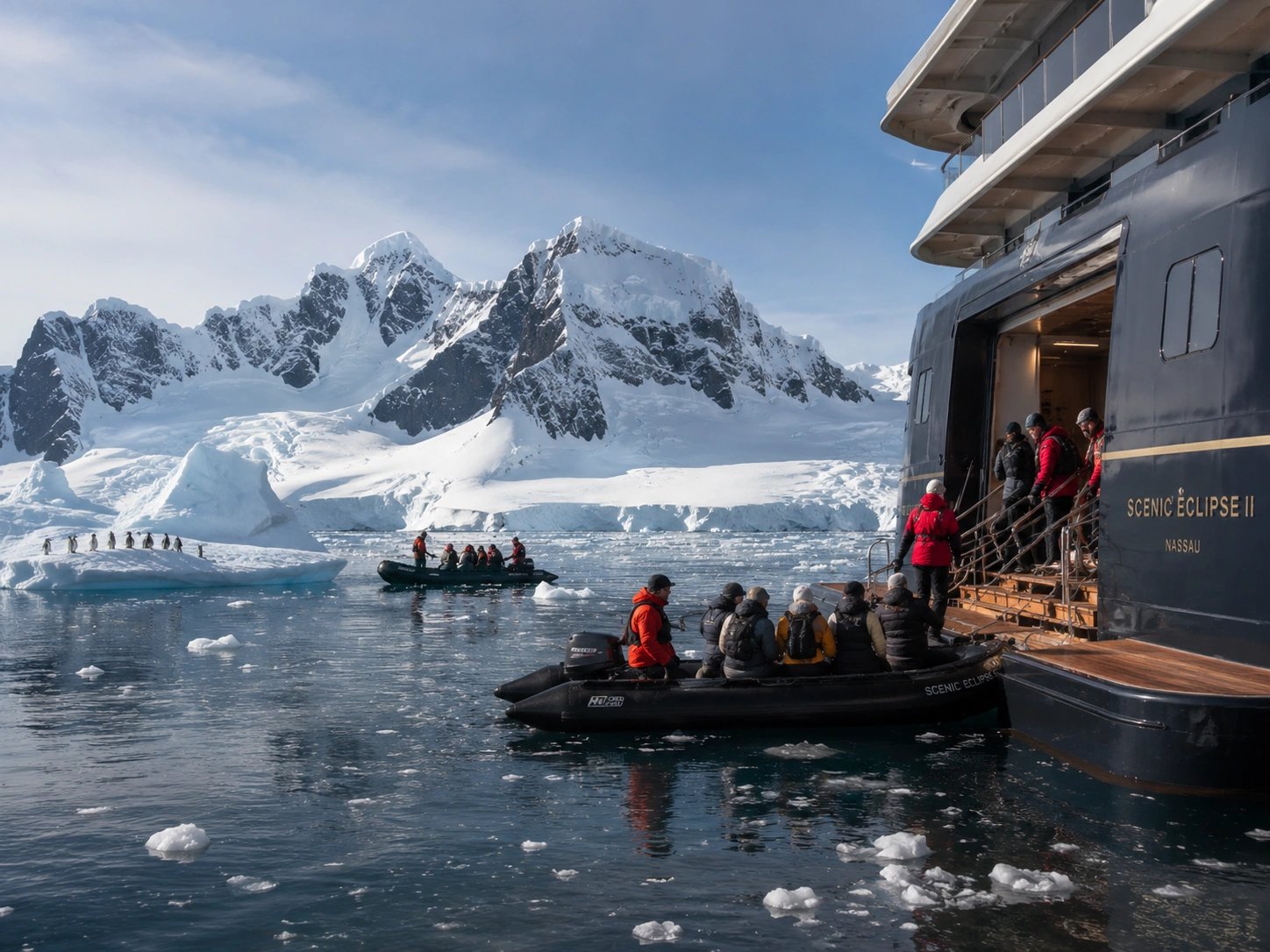
Few destinations feel as untouched as Antarctica. The journey itself becomes part of the experience, with expedition specialists leading travellers through one of the planet's most extraordinary environments. Luxury expedition voyages often include Zodiac landings, penguin colonies, whale watching, glacier exploration, and polar photography. It remains the ultimate bucket-list journey for adventure explorers.
"Antarctica has a remarkable way of changing your perspective. It reminds you how extraordinary our planet really is."
Amisha Shetth
Svalbard & The Arctic
Located far above the Arctic Circle, Svalbard offers access to one of the world's least-visited regions. Experiences include polar expeditions, icebreaker voyages, polar bear tracking, wildlife observation, and viewing the Northern Lights. For many experienced travellers, Svalbard represents exploration in its purest form.
Bhutan
Bhutan measures success differently. Its emphasis on sustainability, culture, and Gross National Happiness has made it one of the world's most distinctive luxury destinations. Luxury journeys frequently include boutique lodges, monastery visits, private cultural experiences, wellness programmes, and Himalayan trekking. Travellers often leave Bhutan feeling restored rather than simply entertained.
Patagonia
Patagonia combines dramatic landscapes with understated luxury. Rather than building itineraries around attractions, journeys focus on immersion in nature. Experiences commonly include private hiking guides, luxury wilderness lodges, glacier excursions, and horseback exploration. Patagonia appeals to travellers seeking adventure without sacrificing comfort.
Greenland
Greenland remains one of the least-visited destinations on Earth. Its combination of towering icebergs, remote settlements, and dramatic Arctic scenery creates a genuine sense of discovery. Luxury experiences include expedition cruises, helicopter sightseeing, icefjord exploration, and cultural encounters with Inuit communities.
Galápagos Islands
The Galápagos offer one of the world's greatest wildlife experiences. Strict visitor controls help preserve the islands while creating a highly exclusive travel experience. Highlights include luxury expedition yachts, marine wildlife encounters, giant tortoises, and naturalist-led excursions. The result is a destination that feels both educational and unforgettable.
Why Traveller Intent Matters More Than Destination
At Bliss Travels, we believe destinations should be the result of the planning process—not the starting point. Every bespoke journey begins by understanding the traveller first. When you understand the traveller first, the right destination usually becomes obvious.
Definition: Traveller Intent — Traveller Intent represents the core purpose, motivations, and emotional goals behind a journey. Unlike traditional destination-first planning, identifying Traveller Intent is the foundational step of bespoke travel planning, ensuring that pacing, properties, and experiences are selected specifically to fulfill the traveller's personal aspirations.
Rather than asking "Would you like to visit Antarctica or Botswana?" we ask why you are travelling, what pace feels right, what memories you hope to create, and what luxury means to you. Only after answering those questions do we recommend destinations.
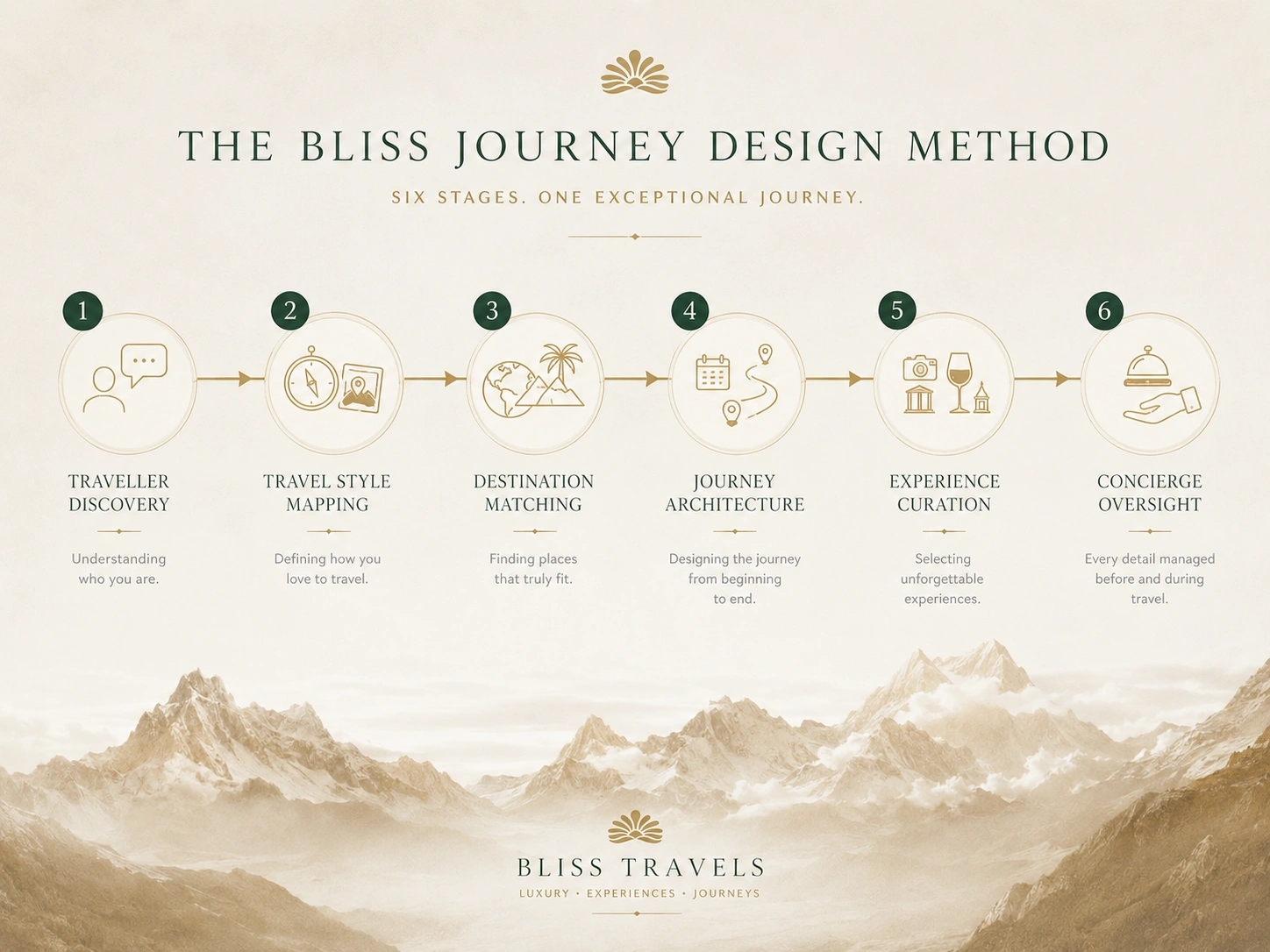
The Bliss Journey Design Method guides this process through six structured stages:
- Stage 1: Traveller Discovery: Understanding motivations, travel style, and expectations.
- Stage 2: Travel Style Mapping: Establishing the natural pacing and comfort boundaries.
- Stage 3: Destination Matching: Aligning geographic locations with core traveller intent.
- Stage 4: Journey Architecture: Structuring flights, transfers, and hotels into a seamless flow.
- Stage 5: Experience Curation: Designing private, exclusive-use excursions and local expert guiding.
- Stage 6: Concierge Oversight: Managing real-time logistics and travel changes behind the scenes.
"Luxury shouldn't feel customised after the itinerary is finished. It should be designed around the traveller before the first destination is ever recommended."
Amisha Shetth
Why Journey Design Matters More Than Booking Luxury Hotels
Luxury hotels are important, but they are not the journey. The most memorable holidays are built around how everything connects together. Journey design coordinates flights, private transfers, expedition schedules, guides, dining, wellness experiences, rest days, and concierge support so that each component works together, making the entire experience feel effortless. True luxury is not measured by how many destinations you visit; it is measured by how effortlessly every destination connects to the next.
Definition: Journey Architecture — Journey Architecture is the structural design of a travel itinerary. It integrates flights, luxury hotels, transfers, excursions, and recovery periods into a single, cohesive experience. Effective Journey Architecture eliminates disjointed bookings and coordinates every transition to ensure a seamless flow from arrival to return.
Definition: Travel Friction — Travel Friction refers to any logistical delay, unexpected change, or coordination issue that interrupts the travel experience. Bespoke travel design proactively minimizes Travel Friction through continuous concierge oversight, private transfers, and pre-departure contingency planning.
By using Personal Pace Mapping and scheduling dedicated Luxury Recovery Time, we ensure that the transitions between destinations do not drain the traveller's energy reserves. When these transitions are carefully coordinated, travellers remain immersed in the destination instead of managing logistics.
"The finest luxury journeys aren't remembered because nothing unexpected happened. They're remembered because travellers never had to worry when something did."
Amisha Shetth
Definition: Luxury Transition Design — Luxury Transition Design is the operational planning of arrival and departure logistics between travel segments. Real-world applications include direct airside coordinator hand-offs and pre-cleared customs lanes. As a key subset of Journey Architecture, it eliminates Travel Friction by ensuring the traveller never handles luggage or waits for transfers.
Comparison Guide: Which Exclusive Luxury Destination Is Right for You?
| Destination | Best For | Privacy | Pace | Ideal Traveller |
|---|---|---|---|---|
| Namibia | Desert landscapes, photography, solitude | ★★★★★ | Slow | Couples, photographers, HNWIs seeking silence |
| Botswana | Luxury safaris, wildlife, conservation | ★★★★★ | Relaxed | Families, wildlife enthusiasts, multi-generational |
| Antarctica | Expedition cruising, once-in-a-lifetime journeys | ★★★★★ | Moderate | Adventure travellers, explorers, repeat luxury travellers |
| Svalbard | Polar expeditions, remote exploration | ★★★★★ | Moderate | Expedition travellers, photographers, wildlife lovers |
| Bhutan | Wellness, spirituality, reflection | ★★★★★ | Slow | Wellness travellers, executives, couples |
| Patagonia | Hiking, dramatic scenery, adventure | ★★★★☆ | Active | Active couples, nature lovers |
| Greenland | Ice fjords, Arctic expeditions | ★★★★★ | Slow | Experienced travellers seeking true remoteness |
| Galápagos | Wildlife, conservation, family exploration | ★★★★☆ | Relaxed | Families, naturalists, first-time expedition |
"The best journeys don't leave travellers saying, 'That hotel was incredible.' They leave them saying, 'I've never travelled in a way that felt so completely right for us.'"
Amisha Shetth
Frequently Asked Questions
What makes a luxury destination truly exclusive?
The world's most exclusive luxury destinations are typically defined by privacy, low visitor numbers, personalised experiences, exceptional local expertise, conservation, and thoughtfully designed journeys rather than luxury hotels alone.
Which destinations are considered the most exclusive for HNWIs and UHNWIs?
Destinations frequently chosen by HNWIs and UHNWIs include Namibia, Botswana, Antarctica, Svalbard, Bhutan, Patagonia, Greenland, and the Galápagos Islands because they offer exceptional privacy, remote landscapes, and highly personalised experiences.
Why does traveller intent matter more than the destination?
Luxury journeys become more meaningful when they begin by understanding the traveller's motivations, travel style, pace, and personal goals before selecting destinations, hotels, or experiences.
What is the Bliss Journey Design Method?
The Bliss Journey Design Method is a proprietary six-stage luxury travel planning framework developed by Amisha Shetth. It begins with Traveller Discovery and Travel Style Mapping before designing destinations, accommodations, private experiences, and concierge support around each traveller.
Why do many affluent travellers prefer bespoke journeys instead of standard luxury tours?
Bespoke luxury journeys offer greater privacy, personalised pacing, specialist local guides, flexible itineraries, and seamless concierge support. Rather than adapting travellers to a package, every element of the itinerary is designed around their individual preferences.
About the Author